Project Solara: Platform for Agent-First Devices
- Client
- Microsoft
- Year
- 2026
- Scope of work
- Lead DesignerProduct StrategyInteraction DesignAdaptive & Generative UIScenario Design
- Location
- Seattle
Project Solara is Microsoft's agent-first device platform, announced at Build 2026. It's built on the premise that the next platform shift is from apps to agents — from opening software to expressing intent, with interfaces that adapt to the person, the device, and the moment.
Opportunity
What changes when agents become the new interface between people and technology?
Project Solara is Microsoft's chip-to-cloud platform for agent-first devices — computers designed to run agents instead of traditional apps. This platform breaks down the barriers of today's computing: switching apps, crossing screens and devices, juggling ecosystems to complete a single task.
Agents on Solara build what you need based on your context through just-in-time UI, composing the interface for the moment and adapting to the device, screen, content, and mode of interaction (voice, visual, touch, multimodal). This open platform enables organizations to build their own agents and devices for specialized workflows, with privacy, security, and user control built into the foundation.
My role
I was the lead product designer on Project Solara from early incubation through its announcement at Build 2026, working within Applied Sciences, Microsoft's R&D group for next-generation computer interaction.
I owned the UX direction for the platform's two concept devices — the desk device and the badge — designing the end-to-end experience from early product envisioning through production-ready specs and working builds. The work spanned the interaction patterns that let one agent experience adapt across form factors, the design systems that unified hardware and software, and the trust patterns that make an always-available agent acceptable in shared spaces.
I grounded the platform in real workflows — healthcare, frontline, and knowledge work — and led the design/dev partnership that carried it from concept to prototype, working alongside engineering, hardware, and partner teams across Microsoft.
A new multi-modal interaction model
For an agentic platform, user intent drives the interaction model. What are the building blocks of an intent-driven OS?
- Input. Expressing what you want matters more than executing how it gets done, so the input model is built around the fastest path to intent in the moment. Voice, because asking is faster than navigating, and an agent can be a thinking partner out loud. Touch, because sometimes tapping a confirmation is faster than saying it. Visual, with progressive disclosure: show me what I asked for, then let me go deeper. And multimodal combinations of all three, because real interactions don't sort themselves into input categories.
- Just-in-time UI. Models can already generate content, images, and layouts tailored to context. Brought into the agent loop, that capability means an agent can adapt its visual, voice, or multimodal interface to whatever device it's running on, without redesigning the experience for every form factor. Just-in-time UI exists on a spectrum defined by how much structure is required to render an experience. On one end is responsive UI: highly structured interfaces that reflow predictably across screen sizes. On the other end is fully generative UI, a future state in which AI creates the interface frame by frame with minimal predefined structure.
- Adaptive, scalable UX. This platform meets you in the moment: in motion, in outdoor conditions, loud working environments, across the table or at arm's length away. The design system is built for legibility before density. Components run edge to edge, using every millimeter of small screens. A dark theme dissolves the display into the hardware bezel. Battery life shapes the system too: simple text layouts and low-frame animations that adapt easily to e-ink displays, extending battery life and durability. The type ramp and touch targets are scaled for distance and for interaction without precision, including gloved hands.
Grounding in real workflows
New technology usually starts from the capability, not from the problem it solves.
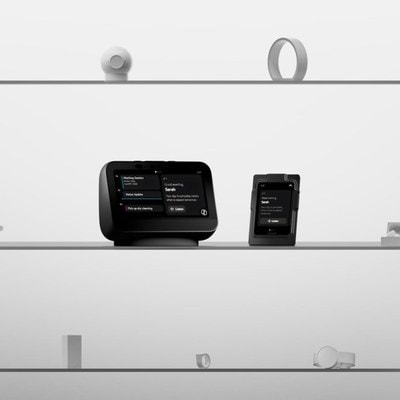
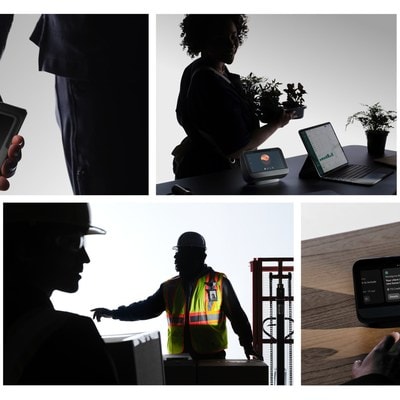
We designed against three verticals — healthcare, frontline work, and information work — learning the real problems and inefficiencies in each, and letting their constraints shape the patterns. The work landed on two form factors, a portable badge and a desk device, on one platform that scaled across all of it.
- Healthcare. For nurses, attention is care. Today, a nurse juggling multiple patients moves between phones, computer carts, and complex dashboards to keep documentation current. Sometimes crucial information gets lost, or improperly documented as scribbles on their gloves or napkins. On Solara's badge, their workflow runs through conversation instead: the device records patient interactions and updates documentation behind it, with on-device prompts for what needs capturing, and vision and transcription turning the room into data — capturing blood pressure from a photo, for instance. This lets nurses be fully hands-on with their patient. Trust is designed into the device on both sides: patient and nurse both see that it is recording, and nothing submits without the nurse reviewing first.
- Frontline. Construction and field work stress-test the durability of the badge concept. Their work moves between office and site, through variables like weather, noise, and low connectivity. The design of the device shows rather than tells: large type for visibility in sunlight, an e-ink screen that powers down while preserving its image so a worker can reference it without authenticating, and a hardware capture button that can drive the entire screen and keeps the device usable with gloved hands.
- Information work. Knowledge work fragments attention: notifications across monitors, meetings stacked against email, the constant tax of deciding what matters right now. The desktop device answers that with a companion built for the glance — frictionless biometric authentication, a curated view of only the most critical items, and a voice-first thought partner grounded in your work data, there when you want to think out loud without breaking flow. It fits the setup rather than fighting it, pairing with your PC to hand off tasks and keep lock state consistent, or becoming a full cloud PC over USB-C when you need it to be.
Priority Agent
Priority Agent is an experimental agent our team is developing to bring actionable insights and actions directly to you.
Grounded in signals across WorkIQ, Priority Agent provides the answer to "what needs my attention right now?" It dynamically curates that list, adding and removing items intelligently, so you only glance at what is needed now. It brings Copilot insights to the forefront of your workflow and adapts to your day, so you can launch, complete, and continue tasks directly from this flow.
Priority is computed from signals that make something matter in the moment: a meeting starting in minutes, a message from your manager rather than an automated account, an escalation over a newsletter. Each card then pairs the item with its single next action — an escalation arrives with "draft reply" — invokable by voice or touch, so seeing and acting are one tap apart.
Trust, control, and enterprise readiness
Privacy, security, control, and trust are at the forefront of an experience built around seamless access to agents. Enterprise customers, device users, and the people around them must be able to understand and control how these devices are used.
At the design level, this means trust is legible at a glance: clear device states for listening, talking, and sleep, backed by hardware you can verify — a physical mic switch, visible recording indicators, camera access only with permission. User control extends to what the agent produces: agents don't act without user permission or review.
At the enterprise level, the platform is built with manageability, security, and privacy protections to securely access services. This includes biometric and multi-step authentication, and device management that lets IT admins secure these devices just like PCs and mobile today.
Piloting at scale
These concepts weren't kept in the lab. Hundreds of employees across Microsoft used the devices in their daily work, generating feedback that fed directly back into the design — and the platform is now moving into pilots with industry partners while we explore what agent-first devices could mean for scenarios beyond the first verticals.
Press
- Microsoft's Project Solara is an OS for AI agent gadgetsThe Verge
- Microsoft announces Project Solara, its take on an AI agent platformEngadget
- Inside Microsoft's Project Solara: A new platform for devices that run AI agents instead of appsGeekWire
- Microsoft just announced a new operating system for devices that don't run apps, only AI agentsThe Next Web